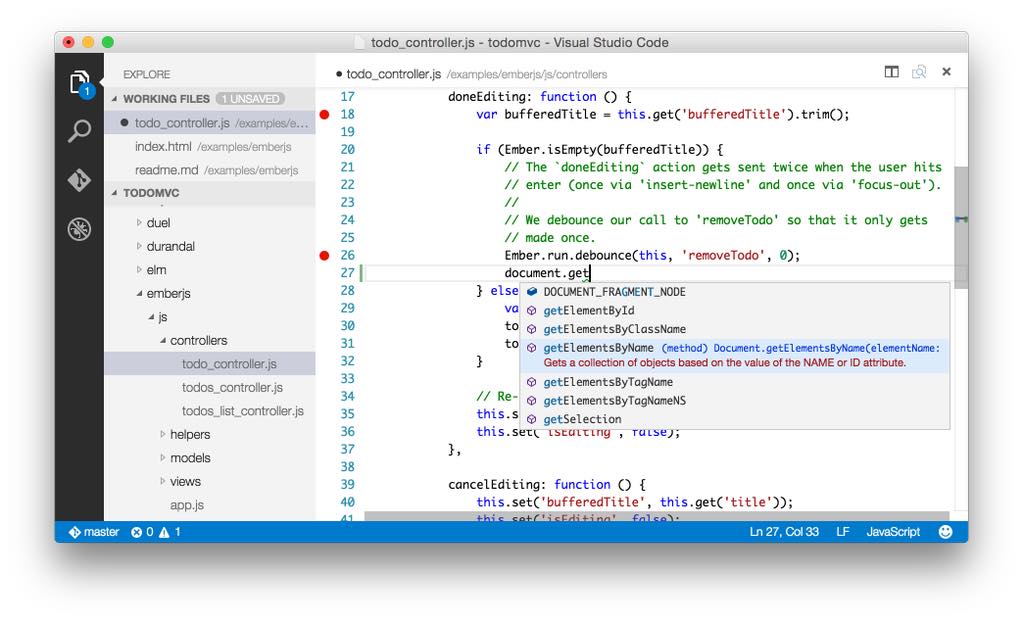
Visual Studio allows developers to code applications using Microsoft's integrated development environment (IDE) on Apple's macOS platform, which they can sync across both Windows and Mac devices. Windows 10.0 visual studio 2017 version 15.5 ide Sebastian Klatte reported Jan 16 at 10:52 PM Starting with 15.5 the green/full connection to the mac does not work most of the times, because the IDB agent could not be started.
- Visual Studio For Mac Free
- Visual Studio In Mac
- Visual Studio For Mac Os
- Install Visual Studio For Mac
- Crack Visual Studio For Mac
- Free Visual Studio For Mac
Microsoft Build has always been a time when we deliver a wealth of developer-focused announcements. It’s an opportunity to share our vision for developer experiences across mobile, AR/VR, cloud, web, desktop, IoT and AI. This year, I’m excited to have brought this vision to life with more than a few exciting announcements:
For an overview of announcements across the company, check out Scott Guthrie’s blog post; but for a round-up of Visual Studio and .NET headlines, read on.
.NET Core 2.1 RC
As of today, .NET Core 2.1 Release Candidate (RC) is available with a “Go-Live” license to use in production. .NET Core 2.1 improves on previous releases with hard-won performance gains and many new features:
- ASP.NET Core SignalR. Developers have been using SignalR to build real-time web communication solutions since 2013 on the .NET Framework. The stack has been streamlined and improved to run on the cross-platform and higher performance .NET Core runtime. We also released SignalR as an Azure service.
- ASP.NET Core web platform enhancements including support for Razor UI in class libraries, improvements in building WebAPIs, security enhancements, a new Identity UI library and HttpClientFactory.
- Entity Framework Core 2.1 introduces significant capabilities like lazy loading, data seeding, value conversions, query types, and GroupBy translation.
- .NET Core 2.1 significantly improves build & runtime performance. It also introduces a new deployment and extensibility model for global tools.
- ASP.NET Core 2.1 is more than 15% faster than version 2.0. This means that when ASP.NET Core is released, it will top the TechEmpower benchmarks as the fastest mainstream web framework on the planet.
Of course, .NET Core remains free, cross-platform, and open source – just as it has been since 2014.
Learn more about .NET Core 2.1 RC.
Future of Windows Desktop Development
While we’re excited to release .NET Core 2.1 RC, we’re not stopping there. Today, we introduced the roadmap for .NET Core 3, which brings desktop development to our open source .NET stack. We are adding Windows Presentation Foundation (WPF) and Windows Forms on top of .NET Core. As always, developers building Universal Windows Platform apps will also continue to benefit from all the .NET Core improvements.
.NET Core 3.0 will enable Windows desktop apps use a globally installed .NET, or an app local copy, or build a single .EXE which includes .NET. Thus, .NET apps will no longer be impacted by system-wide updates. More importantly, this will allow us to make improvements to WPF and Windows Forms that we previously could not have done with .NET Framework without risking compatibility to existing apps
With .NET Core 3.0, developers will have the ability to share and easily integrate UI controls across all the major Windows desktop frameworks. You’ll be able to incorporate whatever UI controls make the most sense for your scenario, or even take a phased migration approach to modernizing your app’s UI. Developers will be able to seamlessly integrate almost all the Windows 10 API surface area into their .NET apps such as Cortana, Windows Hello, Windows ML, Rome, and more. And developers will be able to take advantage of the performance improvements and new API’s in .NET Core.
Developers targeting .NET Framework 4.8, the next version of .NET Framework, will also benefit from the improvements we plan to make such as the new Edge-based WebView control that they can host inside their apps, with more controls planned. And support for XAML Islands bringing UWP UI into existing applications.
This roadmap represents a significant investment in Windows desktop development by empowering developers to adopt the latest innovations in Windows 10 and .NET Core in their WPF and Windows Forms apps.
Visual Studio For Mac Free
Visual Studio 2017, version 15.7
Our flagship IDE, Visual Studio, received a significant upgrade today with the announcement of Visual Studio 2017 version 15.7. John Montgomery’s blog post has a full run-down of all the new capabilities, but some of the more significant headlines include:
- Cloud development: You’ll find several improvements to the project scaffolding and unit testing. Additionally, you can publish Helm charts directly to Azure Kubernetes Service (AKS). You can now also directly publish .NET applications to Kubernetes containers. For your ASP.NET and ASP.NET Core applications, you can configure the Key Vault connected service directly from the IDE.
- Debugging: IntelliTrace’s new step-back debugging, first shipped in Visual Studio 2017 version 15.5, is now available for .NET Core applications. The feature automatically takes a snapshot of your application on each breakpoint and debugger step so you can step “back in time” to view previous application states.
- MSVC C++ 17 conformance: Today, we are happy to announce we have reached full C++ 17 conformance in MSVC with Visual Studio 2017 version 15.7. We also added ClangFormat support for C++ developers in the IDE. Developers can use ClangFormat to automatically style and format your code as you type, in a way that can be enforced across your development team.
- Python: This release contains an opt-in preview of the Python debugger based on the popular open source pydevd debug engine, offering improved performance for many debugging scenarios.
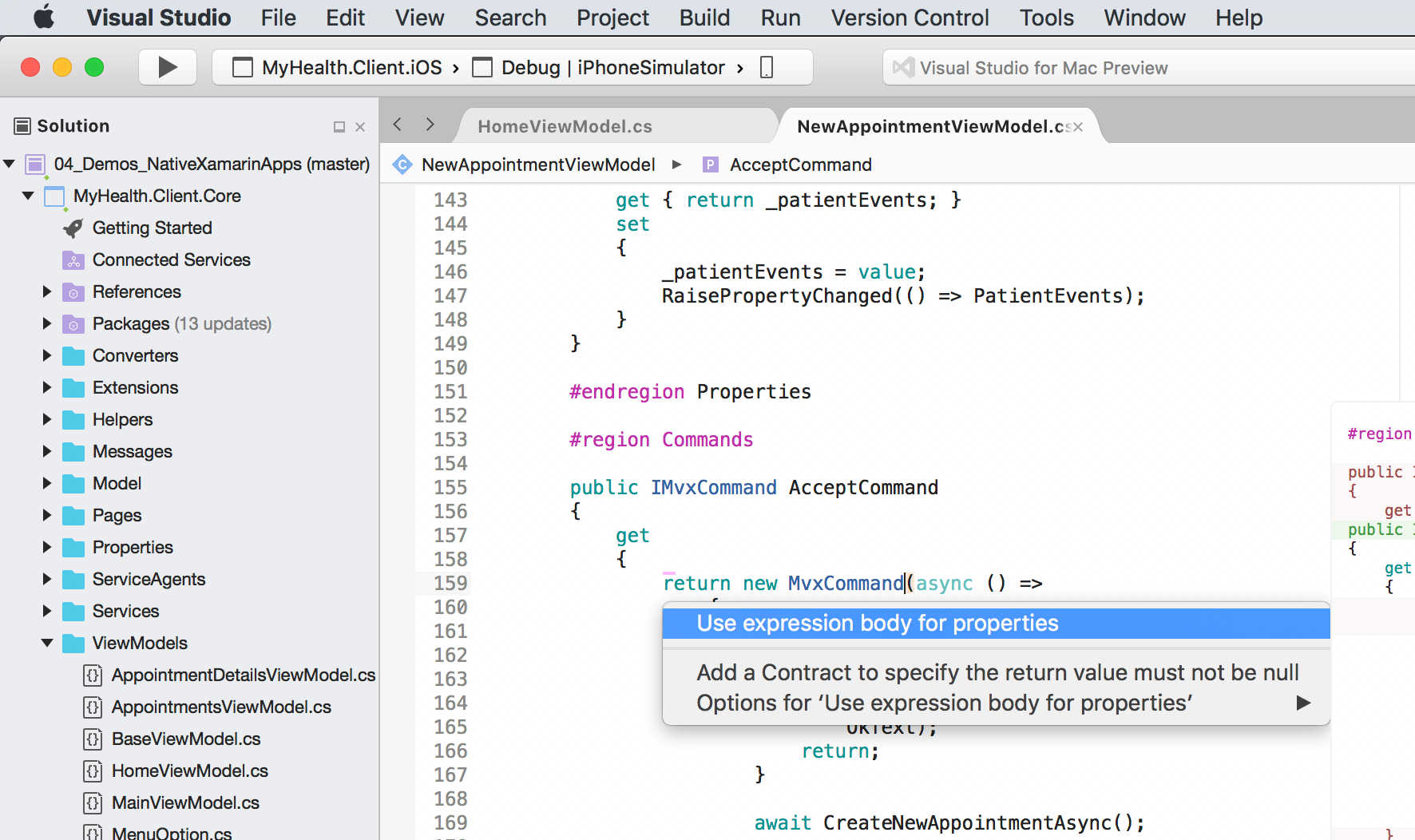
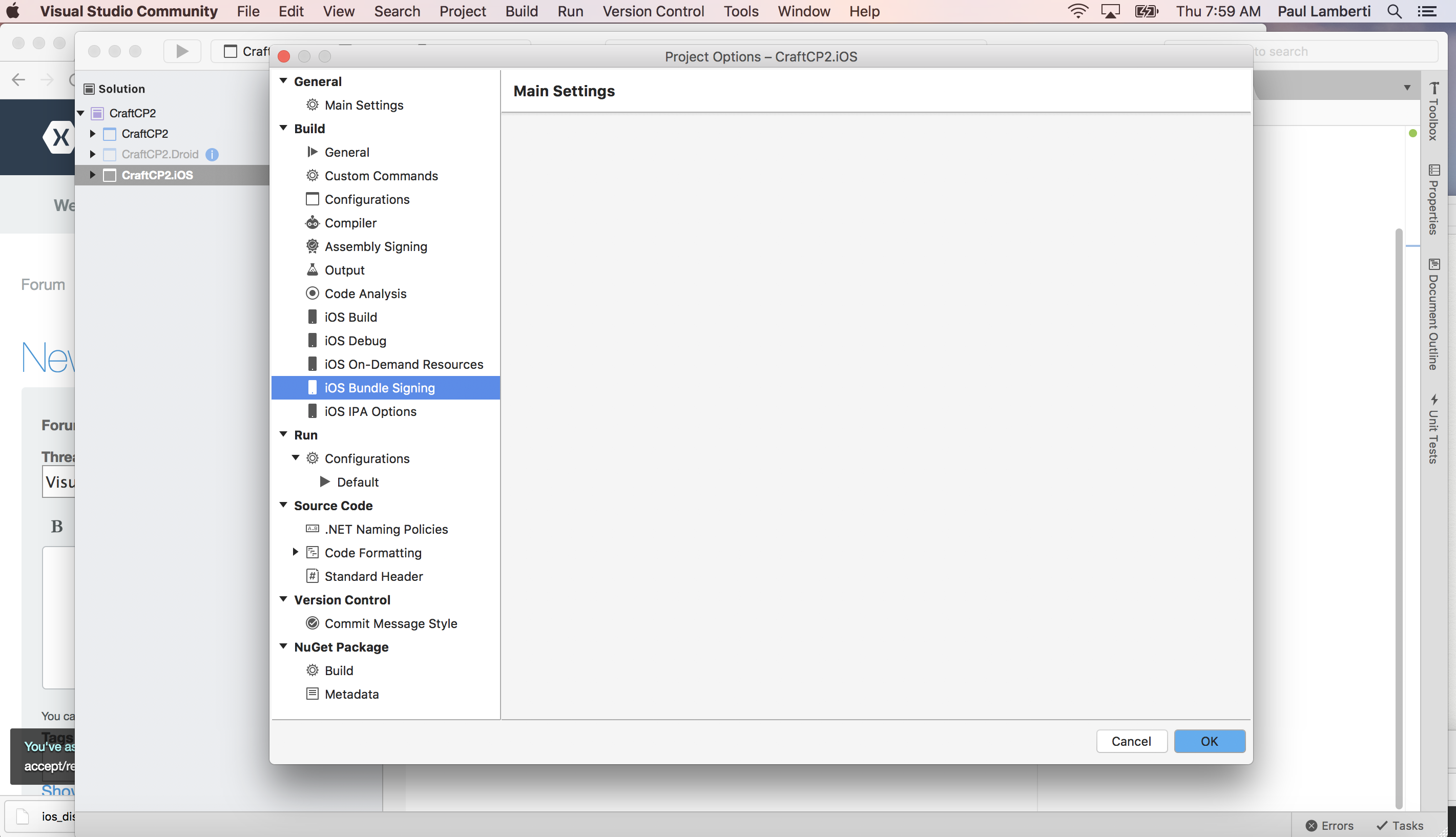
- iOS and Android mobile development with Xamarin: The XAML editing experience has been greatly improved with full IntelliSense support. iOS devices can be provisioned for development with a single click, saving developers a lot of time and steps. Android and iOS project templates have been re-written to use the latest modern navigation patterns and are now better organized for improved discoverability.
Visual Studio for Mac, version 7.5
Visual Studio 2017 wasn’t the only IDE to get an update. Today, we’re announcing Visual Studio for Mac version 7.5. This release includes bug fixes, performance improvements, and several new features:
- New editors for Razor, JavaScript, and TypeScript for building web projects
- Updated UI and templates for building serverless solutions with Azure Functions and .NET Core
- .NET Standard Library projects are now a fully supported option for sharing code between platforms when building Xamarin.Forms solutions.
- Preview support for Team Foundation Version Control (TFVC) in Team Foundation Server (TFS) and Visual Studio Team Services (VSTS) has arrived addressing one of our top UserVoice requests. Developers now have the option to use the existing Git source control integration or the new TFVC integration to manage their code.
Xamarin.Forms 3.0 General Availability
Today, we’re announcing immediate availability of Xamarin.Forms 3.0. Xamarin.Forms 3.0 delivers improved stability, faster performance, and new capabilities aimed at making it easier for you to create beautiful apps that work on Android, iOS, macOS, and Windows devices.
Xamarin.Forms 3.0 now builds with .NET Standard 2.0 using multi-targeting, while still maintaining support for PCL profiles and other .NET Standard versions. Projects load much faster when you use .NET Standard project types.
Xamarin.Forms 3.0 also includes a strong focus on developer productivity. Many developers are already familiar with the Visual State Manager already found in XAML for UWP and WPF. It’s now available for Xamarin.Forms, too. We’ve also heard from many ASP.NET developers who can build amazing layouts for the web using Flexbox and CSS. To empower these developers to build equally impressive layouts on mobile, we’ve added two features to Xamarin.Forms: FlexLayout and CSS. Xamarin.Forms 3.0 introduces both features without compromising the existing XAML experience desktop developers have come to know and love. Finally, because Xamarin apps are deployed globally, we also included right-to-left language support and many quality improvements in the 3.0 release.
Visual Studio Live Share Public Preview
Visual Studio In Mac
Today, we announced the public preview of Visual Studio Live Share. Now any developer can use Live Share to collaborate in real-time with other developers, with instant bi-directional collaboration directly from their existing tools like Visual Studio 2017 and Visual Studio Code. With Visual Studio Live Share:
- It doesn’t matter if the developer sharing doesn’t use the same editor or have the same OS as you; join a Live Share session from your own development environment. No need to install project- specific dependencies or configure runtimes. You’ll view the project in your development tool, retaining all your customizations and themes.
- Each team member in a Live Share session can separately open files, navigate, edit, and refactor code. Your changes are instantly reflected in your teammate’s editor. You can quickly jump to a teammate’s location and see their cursor as they make edits or pin to follow their actions. Want to focus their attention? Highlight a piece of code and it will highlight on their screen as well.
- Use Live Share with any language on any application pattern, including serverless, cloud native, and IoT development. At Connect() 2017, we showed Live Share working with JavaScript and Node.js. Today, Live Share supports nearly every language supported by your development tool, including C#, Python, Java, Go, C++, and
- Full-context sharing – Use Live Share to collaborate across all parts of your development workflow: co-editing, shared debugging, shared terminals, and shared servers (ports).
Visual Studio IntelliCode
Visual Studio IntelliCode is a new capability that enhances everyday software development with the power of AI. Today, IntelliCode provides intelligent suggestions to improve developer productivity and code quality in the tool that developers love, Visual Studio. Our vision is to apply AI to empower developers across the entire development lifecycle.
At Build, we shared a sneak peak of IntelliCode, showing how it uses AI to deliver better context-aware code completions, guide developers to code to the patterns and styles of their team, find difficult-to-catch code issues, and focus code reviews on areas that really matter.
Developers can sign up for news and a future private preview, as well as gain access to an experimental extension at http://aka.ms/intellicode
Send us Your Feedback
Our developer tools and services are shaped by your feedback, so please let us know what you think. To download, install and read documentation for all today’s announcements, go to:
If you have any trouble, you can report a problem from inside the IDE on both Visual Studio and Visual Studio for Mac.
Visual Studio For Mac Os
To track issues, ask questions and find answers, explore the Visual Studio Developer Community. Or, to engage with our team and other Visual Studio developers in real-time chat, try our new Gitter community (requires GitHub account). We welcome your product suggestions through UserVoice. And, should you need it, you can also get free installation help through Live Chat Support.
Finally, don’t forget that we have three full days of announcements, deep dives, and developer interviews to share. You can live-stream or watch on-demand video later from the Microsoft Build website.
Install Visual Studio For Mac
Happy coding.
Thanks to integration with Xamarin, a cross-platform software development company that Microsoft acquired last year, Visual Studio encourages macOS and iOS developers 'to use Microsoft’s development tools, since they will no longer need a Windows computer or virtual machine to do so.' Xamarin Studio is expected to eventually close for good following a full integration into Microsoft.
“Developers get a great IDE and a single environment to not only work on end-to-end solutions — from mobile and web apps to games — but also to integrate with and deploy to Azure,” Scott Guthrie, executive vice president of the Microsoft Cloud and Enterprise group, said in a statement. “Whether you use C#, F#, .NET Core, ASP.NET Core, Xamarin or Unity, you’ll get a best-in-class development environment, natively designed for the Mac.”Visual Studio has been designed natively for macOS, according to Microsoft, letting developers manage their code hosted by any provider, including GitHub and Visual Studio Team Services. Developers can build, connect, and tune native mobile apps for iOS, macOS, and Android while also having the ability to create web applications thanks to support for ASP.NET Core. In terms of programming languages, the C# and F# languages are supported.
There are three different versions of Visual Studio for Mac that users can download, including Visual Studio Community, Visual Studio Professional, and Visual Studio Enterprise. Microsoft markets Community as its free, but 'fully-featured,' IDE for students and individual developers. Professional targets small teams with subscription benefits, while more 'demanding' users and projects with larger scale are suggested to look into Enterprise.
For its cloud subscriptions, there are yearly and monthly options available to users interested in the higher-tier Visual Studio plans. An annual subscription to Visual Studio Professional costs $539/year while a monthly subscription costs $45/month. For Visual Studio Enterprise, users will pay $2,999/year or $250/month. Subscribers will be able to earn small credits back each month for the yearly tiers, contingent on their use of different Azure services.
For a detailed breakdown of the differences between each Visual Studio subscription, including individual licenses, check out the app's new website.
Guides
Upcoming
Front Page Stories
Bloomberg: 2019 iPhones Will Have Centered Apple Logo on Back
What to Expect at Apple's September 2019 Event: New iPhones, Apple Watch Models, Services Updates and More
1 day ago on Front PageApple to Live Stream September 10 Event on YouTube
1 day ago on Front PageU.S. Government Orders Apple and Google to Identify Users of a Gun Scope App
1 day ago on Front PageFifth Avenue Glass Cube Gets Temporary Rainbow Look to Celebrate Reopening
1 day ago on Front PageApple Disputes Some Details of Google's Project Zero Report on iOS Security Vulnerabilities [Updated]
1 day ago on Front PageKuo: 'Apple Tags' to Feature Ultra-Wideband Technology, Likely Far More Precise Than Tile's Trackers
1 day ago on Front PageApple Working on Siri Feature Allowing Back-and-Forth Conversations About Health Problems
1 day ago on Front Page