- Android Sdk Tools Download
- Mac Install Android Sdk
- Get The Sdk Android
- Mac Os Android Sdk
- Android Sdk Tools Mac
- Android Sdk Install
Add SDK tools to path in Android Studio app. Ask Question. Up vote 14 down vote favorite. I have just installed Android Studio 0.2.2. Finding Android SDK on Mac and adding to PATH. How do i add android tools to my path on mac? Android Studio - How to Change Android SDK. The Android Studio is an Android app development software designed to create modern applications and games for mobile devices in the Java environment. If you are a Mac user and are creating programs for Android, you might find this article helpful. Android Studio on Mac OS - Accessing SDK through 'Android Studio.app' Discussion in 'Android' started by alexandre-fiset, Jun 18, 2013.
Android Sdk Tools Download

We will divide this post into three parts.
- Setting up java JDK
- Downloading and installing Android studio
- Setting up Android SDK
- In this post, we will see how to install android studio and get started with android development. I will provide guidelines to install android studio on Mac OS but it will be very much similar in case of windows or linux too.
- The Android SDK (software development kit), which comes with the Android Studio package, does not include everything you need to start developing Android apps. The SDK itself is a utility used to separate your tools, platforms and components into packages by using the Android SDK Manager.
- At the core of Android Studio is an intelligent code editor capable of advanced code completion, refactoring, and code analysis. The powerful code editor helps you be a more productive Android app developer.
- There was no Android Studio for Mac OS 10.13. Currently there is a version that supports Mac OS 10.13. Edit: also, I found out that permission problems may cause unexpected behavior of some apps (Visual Studio Code also broke).
Setting up java JDK:
- Open terminal in Mac OS
- Write “java -version” in terminal as below
- Go to https://developer.android.com/studio/index.html.
- Download dmg file from the link which is on above webpage.
- Double click on dmg file and you will get below screen.
- Drag above android studio to applications.
- Open Android studio app from applications now.
- You will see below screen.
Click on Finish
It will automatically download require SDK platform. Please note that it will take some time to download android SDK files as it is very large in size.
Once done, click on finish and then you will get below screen.
Setting up Android SDK
Mac Install Android Sdk
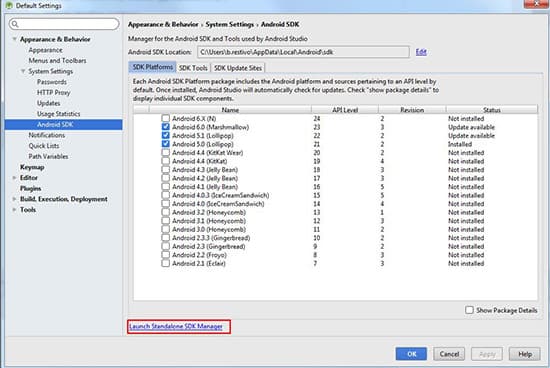 Click on “extras” which you will see at the end.
I have selected items which you need to download and install. Click on install package once you select above selected items.
Once you follow above steps, you have prepared platform for developing android app. Please comment if you find any issues with above steps
Happy Android learning!!
Join Our News Letter – Stay Updated
Subscribe to Awesome Java Content.
We respect your privacy and take protecting it seriously.
Get The Sdk Android
Having issues while trying to set-up Android Studio (latest release, 2.3) on a Mac (El Capitan 10.11.3). Studio is installed, but when I launch it a window for configuring the SDK appears, and after a few passages I get this error:
'An error occurred while trying to compute required packages'
Anyone got this?
fixer12342 Answers
After an update Android studio was not working. So I have uninstalled it and deleted all the local folders related to Android studio. I have tried to install it again but I had faced the same issue.
After some research, I have found out that Android studio was looking for sdkmanager and it is a part of android tools. I have downloaded sdkmanager and extracted it in /Users/<loggeduser>/Library/Android/sdk folder as tools. This solved the problem and wizard downloaded 1.5GB data.
I was able to figure out the answer to my problem. So, to recap...
Mac Os Android Sdk
It seems that Android Studio does not include the command line tools anymore. This is contrary to what stated on the web page for the download of AS. In any case, as suggested in the other answer to this question, first I downloaded the .zip package containing the command line tools (bottom of AS download page) and extracted it in .../android/sdk (the ... is any path you like for the Android components; in my case I am on a Mac and selected /usr/local/). This results in a subfolder called tools.
If you run the wizard, it doesn't work - oh well, to be honest I didn't try with the custom option, which allows selecting the directory for the sdk; maybe this would allow the wizard to see the sdk manager, which is in tools/bin. Anyway, I entered AS and selected, on the bottom, the 'configure' button. From the drop-down menu, 'SDK manager'. It prompts for an SDK location. Clicked 'edit'. Selected as location .../android/sdk. A warning says that no SDK is installed. I tried to go ahead anyway, and successfully installed the sdk (requires some time).
Now, upon restart of AS, the setup wizard won't pop up anymore. But there's a further error: at the bottom of the initial window, a dialog appears saying there are updates for the tools. If you try to install them, you encounter an error (many others noticed this on SuperUser - see here and here). The error is due to a dependence of the tools from the emulator, which has not been installed. Others suggest to use the sdkmanager from the command line to install the emulator, but this didn't work for me since I don't have any Java Development Kit installed yet, and the sdkmanager from command line requires it. So, I did this: clicked again the 'configure' button, selected 'Preferences', and then from the tree which appears on the left selected 'Appearance & Behavior -> System Settings -> Updates'. Here switched, for the update check, from 'Stable Channel' to 'Canary Channel' (seems, based on suggestions on StackExchange, that the emulator is only there). Clicked 'Check Now'. Refused to install updates for the tools. Then selected, on the tree on the left, 'Android SDK', and there, the tab 'SDK Tools'. At this point the Emulator appeared, I selected it, applied settings, and this installed the Emulator and the Tool update from the Canary Channel. Clearly this means that they are less stable, but this is it. Went back to 'Updates' and selected again the 'Stable Channel'.