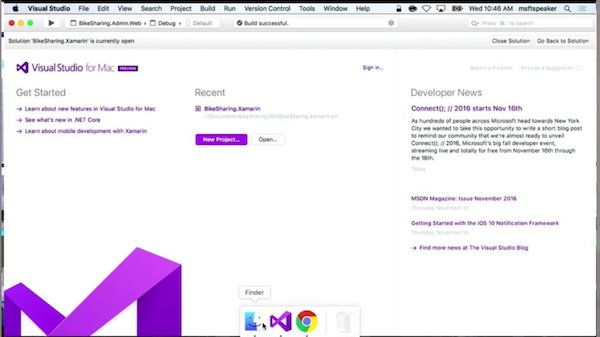
NEW YORK — Nov. 12, 2014 — On Wednesday, Microsoft Corp. Reinforced its commitment to cross-platform developer experiences by open sourcing the full server-side.NET stack and expanding.NET to run on the Linux and Mac OS platforms. Microsoft also released Visual Studio Community 2013, a new. At Connect(); in November, Microsoft is launching a preview of Visual Studio for Mac. This is an exciting development, evolving the mobile-centric Xamarin Studio IDE into a true mobile-first, cloud-first development tool for.NET and C#, and bringing the Visual Studio development experience to the Mac. How to Run Visual Studio on a Mac Visual Studio doesn’t run natively on OS X, so my first step was to get Windows running on my MacBook Pro. (If you want an editor that does run natively, Xamarin Studio or Visual Studio Code might fit the bill). How to Run Visual Studio on a Mac Visual Studio doesn’t run natively on OS X, so my first step was to get Windows running on my MacBook Pro. (If you want an editor that does run natively, Xamarin Studio or Visual Studio Code might fit the bill). Visual Studio Code for Mac & Linux is up for download – free. Apr 29 2015 April 29, 2015 Posted by Iris Classon at 10:09 am Dev Environment Add comments. I’ll keep this short as I am taking notes while watching the BUILD 2015 conference, and they just started talking about Windows 10. Visual Studio for Mac is a fully featured native development environment designed for building cross-platform applications with Xamarin and.NET Core on macOS. The IDE enables productivity through a rich set of features and tools, combined with powerful customizations that allow developers to.
- Visual Studio 2017 For Mac
- Visual Studio Express Download
- Visual Studio 2012 Download
- Visual Studio 2015 For Mac
- Visual Studio 2014 For Mac Review
The first step in building an ObjectARX application is to set up a project in Microsoft Visual Studio. This section lists the project settings and minimum files required to build a basic ObjectARX application.
Alternatively, you can create a new ObjectARX project using the ObjectARX Wizards for AutoCAD, which you can install from the ObjectARX utilsObjARXWiz directory.
Use the following settings for your project
- Set the application type to DLL.
- Specify the ObjectARX library and include file locations.
The easiest way to do this is to add the ObjectARX include and library directories to your MSVC++ environment settings (in the Microsoft Visual Studio menu under ToolsOptionsProjects and SolutionsVC++ Directories). You can also specify the locations in the Project Properties, but you'll need to include full paths to the files for every project you create.
- For all configurations (debug and release), set the runtime library for linking to Multithreaded DLL (in your project’s Property Pages under Configuration Properties folderC/C++ folderCode GenerationRuntime Library).
- For all configurations (debug and release), set the Detect 64-bit Portability Issues option to No (in your project’s Property Pages underConfiguration PropertiesC/C++ folderGeneralDetect 64-bit Portability Issues). This setting suppresses compiler warning 4311 for pointer assignments that are not 64-bit compatible. Some ObjectARX header files contain such assignments.
If you prefer, you can control this warning instead by using #pragma warning statements. See the Microsoft documentation for more information about #pragma warning statements.
- Set the output file name (in your project’s Property Pages under Configuration PropertiesLinkerGeneralOutput File) to a name with an .arx extension. If you include a DEF file with a LIBRARY statement in your project, this name should match the LIBRARY value. Note
LIBRARY statements are optional in DEF files.
- Add the ObjectARX libraries necessary for your program (in your project’s Property Pages under Configuration PropertiesLinkerInputAdditional Dependencies).
For example, the minimum code shown below requires rxapi.lib and acdb18.lib.
You will need to add source file(s) to the new project. If you already have source files or are using sample program source files, add these files.
Visual Studio 2017 For Mac
This example shows the minimum code needed to make an ObjectARX program.
Visual Studio Express Download
Add a new C++ source file to the project and enter the following code:
The project also needs a definition file. Add a new text file to the project and name it with a .def extension.
Enter the following code in the DEF file
The EXPORTS section should be present and must contain at least the acrxEntryPoint function (unless you have used another mechanism to export this function, like the Windows _declspec(dllexport) convention).
Using PRIVATE in the DEF file prevents these symbols from appearing in an import library for this ObjectARX application. The symbol will still appear in the application's export table, allowing AutoCAD to find and call the symbol. This is important because every ObjectARX application or Object Enabler must have its own implementation of these functions. The application gets the implementation of acrxGetApiVersion by virtue of linking to the static library rxapi.lib. If ObjectARX application app2 uses symbols from ObjectARX application app1 by linking to app1.lib, it would be an error for app2 to get its definition of acrxGetApiVersion from the app1 import library. Using PRIVATE in the DEF file will prevent this. Making certain to link to rxapi.lib prior to linking to any import library for another ObjectARX application will also prevent this.
The LIBRARY name should match the file name of the ObjectARX file you are going to create and must show an .arx extension. For example, if your desired output file name is test.arx, the LIBRARY statement in your DEF file should show the full name test.arx.
Visual Studio 2012 Download
Once you have added these two source files, you can build a basic ObjectARX application.
Visual Studio 2015 For Mac
To test the application, start AutoCAD and load the program using one of the following methods
- Use the AutoLISP function (arxload 'program_name').
- Use the ARX command.
- Use the APPLOAD command, which opens a dialog allowing you to maintain a list of applications to load/unload.
For more information, see Loading an ObjectARX Application.